


November 23, 2026
Antonio Ray Harvey | California Black Media
Gov. Gavin Newsom’s plan to change every death sentence in the state to life without the possibility of parole has drawn support from prosecutors who say capital punishment is costly, racially unequal and ineffective. At the same time, the governor faces a lawsuit filed by prosecutors and victims’ advocates who argue the sweeping action bypasses legal safeguards and victims’ rights.
At a Nov. 17 news conference hosted by Prosecutors Alliance Action, current and former prosecutors defended Newsom’s decision. The event happened a day after the district attorneys of 30 counties and other plaintiffs petitioned the California Supreme Court to block the plan.
Cristine Soto DeBerry, the alliance’s executive director, said California’s death penalty fails to make communities safer despite its high cost.
“I have spent most of my career in prosecution, and I know that these decisions can carry enormous weight,” DeBerry said. “Prosecutors have enormous responsibility to hold people accountable for serious crimes while also ensuring that our justice system is fair, reliable, and keeps the public safe. California’s death penalty fails these tests.”
“It’s extraordinarily expensive, it is plagued by racial disparity and risk of wrongful conviction, and unfortunately, has not made our communities safer,” DeBerry added.
A 2011 Death Penalty Information Center (DPIC) study estimated that California’s death penalty system costs about $184 million a year, which exceeds the cost of sentencing people to life without parole. The estimate included expenses for capital trials, appeals, legal representation and death row security. It was not an estimate of legal costs alone.
California has not executed anyone since Jan. 17, 2006, when Clarence Ray Allen was put to death. The state has carried out 13 executions since executions resumed in 1978. A year before, 51-year-old Stanley “Tookie” Williams was executed on Dec. 13, 2005. Williams had spent 24 years and seven months on death row before he was executed.
“These failures come at a real human cost,” DeBerry said.
The racial makeup of death row is another concern for opponents of capital punishment. The California Department of Corrections and Rehabilitation reported 561 people with condemned sentences as of Nov. 4. Of those, 182, or about 32% were Black, the largest group in the report.
The department’s count can differ from the governor’s tally because it may include people whose sentences have been overturned but who are awaiting resentencing, as well as delays in updating records.
In April 2024, the American Civil Liberties Union and other groups challenged California’s death penalty statute, arguing it violates the state Constitution’s equal protection guarantees. The ACLU cited research finding that Black defendants were up to eight times more likely, and Latino defendants at least six times more likely, to receive death sentences than similarly situated defendants of other races.
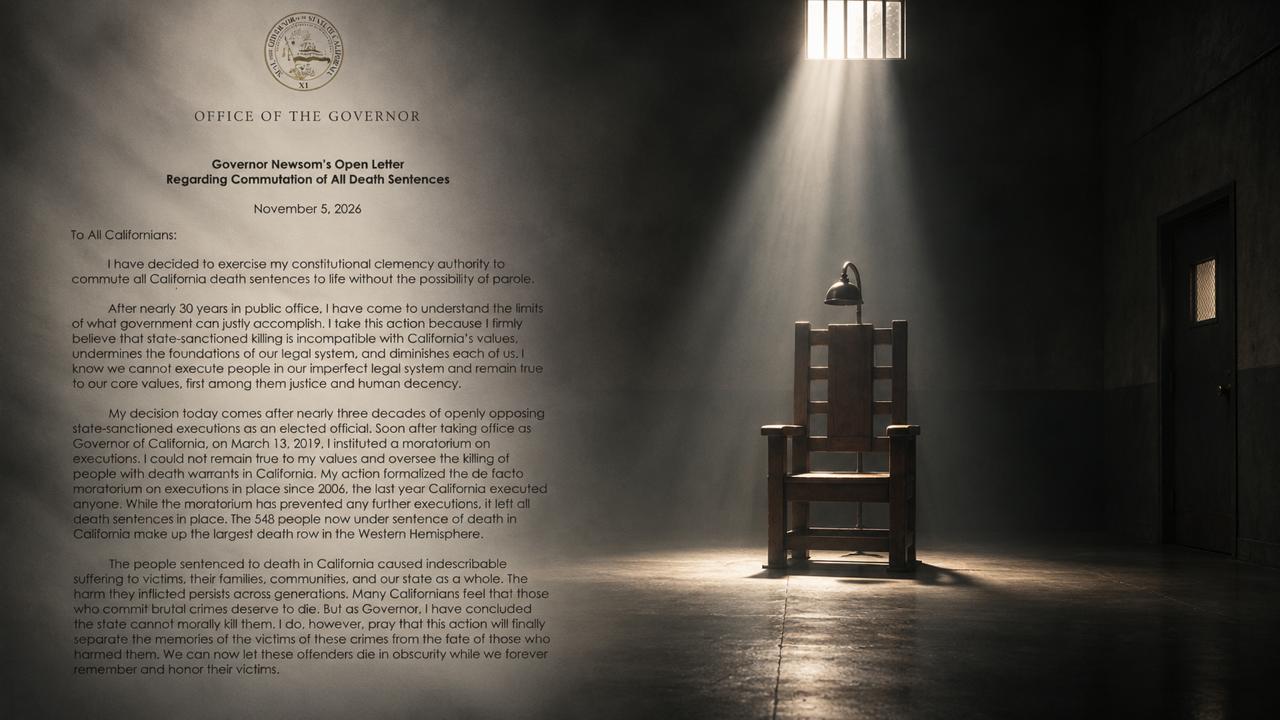
On Nov. 5, Newsom announced that he had decided to commute all 548 death sentences in California to life without the possibility of parole. The group includes 529 men and 19 women. His plan would not release anyone from prison, change their convictions or make them eligible for parole. However, the commutations had not all been formally completed: 382 people with more than one felony conviction require a recommendation from the California Supreme Court, with at least four justices concurring.
“I take this action because I firmly believe that state-sanctioned killing is incompatible with California’s values, undermines the foundations of our legal system, and diminishes each of us,” Newsom wrote in an open letter announcing his decision.
The ACLU praised Newsom’s plan.
“These commutations reflect what justice demands: an end to a racist, error-prone, and inhumane punishment that has burdened California for far too long,” said Anthony D. Romero, the organization’s executive director. “By taking this step, Governor Newsom has affirmed that the death penalty has no place in California and he showed real courage by confronting racialized injustice head-on.”
The Criminal Justice Legal Foundation, which advocates for crime victims’ rights and enforcement of criminal laws, is leading the challenge.
Its petition, Friend et al. v. Newsom, argues that Newsom’s action violates constitutional procedures and victims’ rights. Plaintiffs say victims’ relatives and prosecutors were not notified before Newsom announced his plan and that he did not conduct meaningful, case-by-case reviews.
Those are the plaintiffs’ allegations; the case is pending before the state Supreme Court.
The petition argues that the constitutional requirement for Supreme Court review of commutations for people convicted of multiple felonies applies to Newsom’s entire plan. It asks the court to block the commutations, including those for people without multiple felony convictions.
“This lawsuit is about protecting the constitutional rights of victims, defending the rule of law, and ensuring that no governor is above the law,” said Anne Marie Schubert, the foundation’s president and CEO. “The Governor’s clemency power does not authorize mass commutations that disregard constitutional safeguards, legally required procedures, or victims’ rights.”
Schubert added, “By predetermining the outcome for every inmate on death row, the Governor has abandoned his responsibility to exercise meaningful discretion. Blanket commutation is not an exercise of discretion. It is an abandonment of it.”
Discover more from Central Valley Voice
Subscribe to get the latest posts sent to your email.


