
August 24, 2026
Antonio Ray Harvey | California Black Media
California Secretary of State Shirley N. Weber is asking voters to help protect the integrity of the November 2026 election by taking one important step: Vote early.
Weber said her office is working to combat misinformation, expand voter outreach and maintain ballot security as California prepares for the Nov. 3 general election.
“We want folks to vote early because there are so many attacks on voting,” Weber said. “We want to make sure everyone gets their ballot in. Don’t wait until the last minute. It will help us immensely in terms of not just reducing time but making sure that your ballot gets counted.”
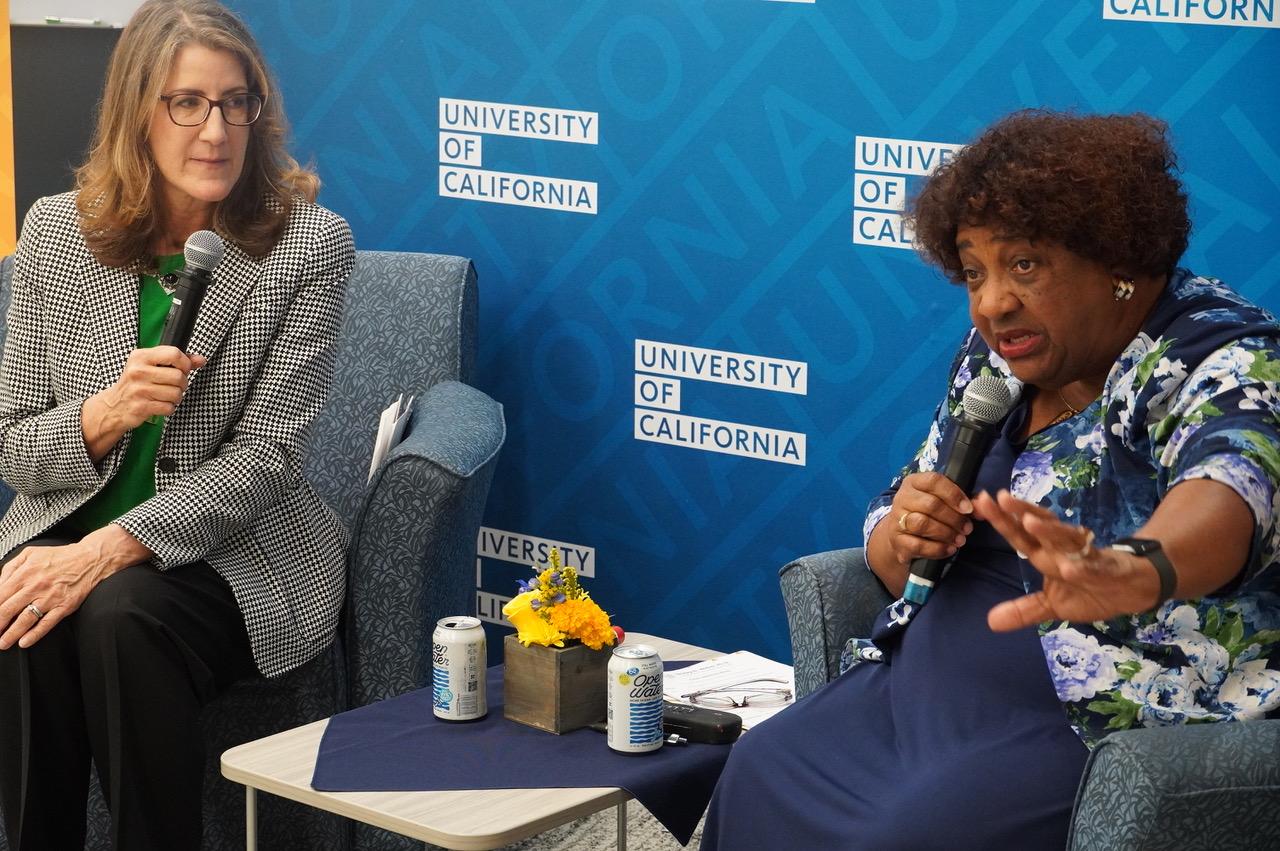
Weber spoke Aug. 18 at the UC Student and Policy Center in Sacramento as part of its California Leaders Speaker Series. She encouraged eligible Californians to participate in the election and avoid waiting until the last minute to return their ballots.
The California Leaders Speaker Series is an ongoing program that provides a platform for public officials, policy experts and state leaders to engage with students and the broader University of California community. According to organizers, the bipartisan series is designed to foster dialogue about significant political and social issues and strengthen connections between the university and the Capitol community.
During the discussion, Weber offered insights into her role as California’s chief elections officer and the preparations underway ahead of the November election.
Former Assemblymember Catharine Baker (R-Dublin), director of the UC Student and Policy Center and a former California Fair Political Practices Commission member, moderated the conversation.
Their discussion focused on election integrity, leadership and the future of democracy. Weber described California’s voting process as a “special system” that empowers people while requiring election officials to manage complex logistical, security and communications responsibilities.
“We have to be careful with this system, our voting systems,” Weber said. “It empowers the people to have their voice heard, and if you treat it right those voices will be heard and adhered to (in terms) of policy and programs.”
Since the June primary, state election officials have worked to provide voters with information intended to help them participate safely, easily and confidently in the general election.
Hours after Weber spoke, U.S. Sen. Alex Padilla (D-Calif.) held a news conference about a mile away at California Democratic Party headquarters to launch a campaign opposing Proposition (Prop) 39, the voter identification measure on the November ballot.
The measure would establish additional identification and citizenship-verification requirements for California voters. Its official ballot label states that it would prohibit citizens from voting unless they present government-issued identification.
Padilla, Assembly Speaker Robert Rivas (D-Hollister), Senate President Pro Tem Monique Limón (D-Santa Barbara), Assemblymember Isaac Bryan (D-Ladera Heights) and other opponents raised concerns about the measure’s potential costs and effects on voting access.
“It’s another voter suppression bill,” Padilla said. “Donald Trump and his MAGA allies are trying to bring their fight here to California, and we’re not going to let them. They know that they’re about to pay a price for their horrible record.”
Supporters argue that Prop 39 would strengthen election security and increase public confidence in the voting process. Assemblymember Carl DeMaio (R-San Diego) is a co-author of the measure.
DeMaio and Reform California, the conservative political action committee he founded, launched the campaign for the Voter Identification, Citizenship Verification, and Registered Voter List Administration Initiative in July 2025.
“Politicians and the media will keep denying the fact that California has real problems with election integrity, but the message from the public is loud and clear in support of requiring Voter ID as the best way to restore public trust and confidence in our elections,” DeMaio stated.
Weber told Baker and the audience that she does not believe California has a voter identification problem. State law generally does not require voters to present identification when casting a ballot, although voters must provide identifying information when registering.
Weber said, “It’s not the fact that voter IDs are bad. The question becomes, don’t we already have it?”
Weber said the state’s existing multistep verification process, which begins with voter registration and includes signature verification for mail-in ballots, provides sufficient election safeguards.
“We do have to verify every piece of mail. We have to make sure that you are actually the person submitting that ballot,” Weber said.

Share this:

Discover more from Central Valley Voice
Subscribe to get the latest posts sent to your email.

